If you own a vehicle in India, you may have heard about HSRP number plates and the government’s rule to make them mandatory. Many vehicle owners still feel confused about what HSRP means, why it is required, and how to get it.
In this complete beginner’s guide, we will explain what an HSRP number plate is, its purpose, legal basis, benefits, and how to apply for it in simple language.
What Is an HSRP Number Plate?
HSRP stands for High Security Registration Plate.
An HSRP number plate is a standardized vehicle registration plate issued by the Government of India. It is designed to prevent vehicle theft, fraud, and misuse.
Unlike old traditional plates, HSRP plates come with advanced security features that make them tamper-proof and traceable.
Every vehicle in India—whether two-wheeler, car, or commercial vehicle—is now required to use an HSRP plate.
Why Was HSRP Introduced in India?
Earlier, vehicle owners could install number plates from any local shop. This created many problems such as:
- Duplicate number plates
- Fake registration numbers
- Vehicle theft
- Illegal activities using stolen vehicles
- Difficulty in tracking vehicles
To solve these issues, the Government of India introduced HSRP under the Motor Vehicles Act.
The main aim was to:
- Improve road safety
- Reduce vehicle-related crimes
- Create a centralized vehicle database
- Ensure uniformity across states
Legal Basis of HSRP in India
The HSRP system was introduced under:
- Rule 50 of the Central Motor Vehicles Rules (CMVR), 1989
- Ministry of Road Transport and Highways (MoRTH)
As per government notification, all vehicles registered before and after April 2019 must have HSRP plates.
If your vehicle does not have HSRP, you may face:
- Traffic challan
- Fine up to ₹5,000
- Vehicle seizure (in some states)
Main Features of HSRP Number Plates
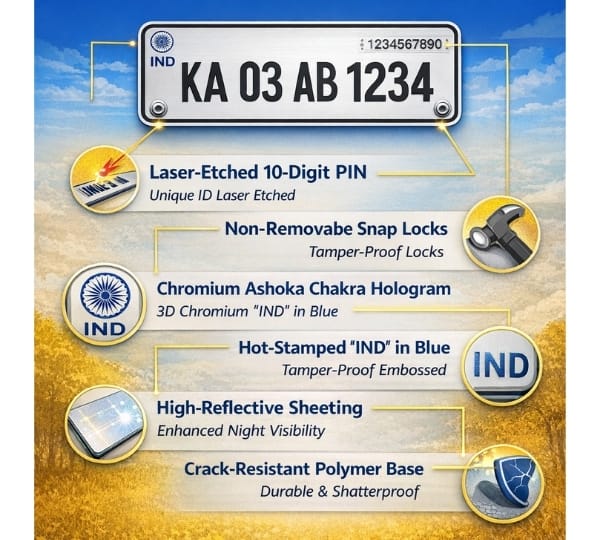
HSRP plates are different from normal plates. They include multiple security elements.
1. Aluminium-Based Plate
HSRP plates are made from high-quality aluminium that cannot be easily bent or replaced.
2. Chromium Hologram
Each plate contains a hot-stamped hologram of Ashoka Chakra, making it difficult to duplicate.
3. Unique Laser Code
Every HSRP plate has a laser-etched unique identification number linked to the vehicle’s chassis and engine number.
4. Tamper-Proof Snap Lock
HSRP plates are fixed using non-removable snap locks. Once installed, they cannot be removed without damage.
5. Reflective Sheeting
The reflective material improves visibility at night and during bad weather.
Benefits of Using HSRP Number Plates
Installing HSRP plates gives several advantages:
✔ Prevents Vehicle Theft
Since plates are linked to the national database, stolen vehicles are easier to track.
✔ Reduces Fake Registration
Duplicate and fake plates become almost impossible.
✔ Helps Law Enforcement
Police can identify vehicles quickly using cameras and scanners.
✔ Improves Road Safety
Reflective plates increase visibility at night.
✔ Mandatory Compliance
Avoids penalties and legal trouble.
Who Needs an HSRP Number Plate?
You need an HSRP plate if:
- Your vehicle was registered before April 2019
- Your vehicle has old black/white plates
- Your plate is damaged or unreadable
- You are transferring vehicle ownership
- You are changing your registration number
Even new vehicles come with HSRP by default from dealers.
Color Codes of HSRP Plates
HSRP plates follow the same color rules as standard plates:
| Vehicle Type | Plate Color | Text Color |
|---|---|---|
| Private | White | Black |
| Commercial | Yellow | Black |
| Electric | Green | Black/White |
| Government | White | Black |
| Rental | Yellow | Black |
How to Apply for an HSRP Number Plate Online
Applying for HSRP is simple and online.
Step 1: Visit Official HSRP Website
Go to your state’s authorized HSRP portal or official vendor website.
Step 2: Enter Vehicle Details
Provide:
- Registration number
- Chassis number (last 5 digits)
- Engine number
Step 3: Select Appointment
Choose your nearest fitment center and time slot.
Step 4: Make Payment
Pay online via UPI, debit card, or net banking.
Step 5: Visit Fitment Center
Go on the selected date to get your plate installed.
Installation usually takes 10–15 minutes.
HSRP Number Plate Price in India (Approximate)
HSRP pricing varies by state and vehicle type.
| Vehicle Type | Approx Price |
|---|---|
| Two-Wheeler | ₹300 – ₹400 |
| Car | ₹600 – ₹1,100 |
| Commercial | ₹800 – ₹1,500 |
Prices may differ slightly depending on location.
Common Myths About HSRP
❌ Myth 1: Old Vehicles Don’t Need HSRP
Truth: All vehicles must have HSRP.
❌ Myth 2: Local Shops Can Make HSRP
Truth: Only authorized vendors can issue HSRP.
❌ Myth 3: HSRP Is Only for New Vehicles
Truth: Old vehicles must also upgrade.
❌ Myth 4: HSRP Is Optional
Truth: It is legally mandatory.
Penalty for Not Having HSRP
If you drive without HSRP, you may face:
- Fine up to ₹5,000
- Repeated challans
- Vehicle inspection
- Possible registration issues
Some states are stricter than others.
Future of HSRP in India
HSRP is part of India’s larger Digital Transport System.
In the future, HSRP will work with:
- FASTag
- VAHAN database
- Traffic surveillance systems
- Smart city cameras
This will improve traffic management and crime control.
Frequently Asked Questions (FAQs)
Is HSRP mandatory for two-wheelers?
Yes, all two-wheelers must have HSRP.
Can I install HSRP myself?
No. Installation must be done at an authorized center.
How long does HSRP last?
Normally 8–10 years with proper care.
What if my HSRP is damaged?
You must apply for a replacement.
Can I transfer my HSRP to another vehicle?
No. Each plate is vehicle-specific.
Conclusion
An HSRP number plate is not just a government rule—it is a major step toward safer roads, reduced crime, and better vehicle management in India.
If your vehicle still has an old number plate, you should apply for HSRP as soon as possible to avoid penalties and legal problems.
Upgrading to HSRP ensures that your vehicle remains compliant, secure, and future-ready.