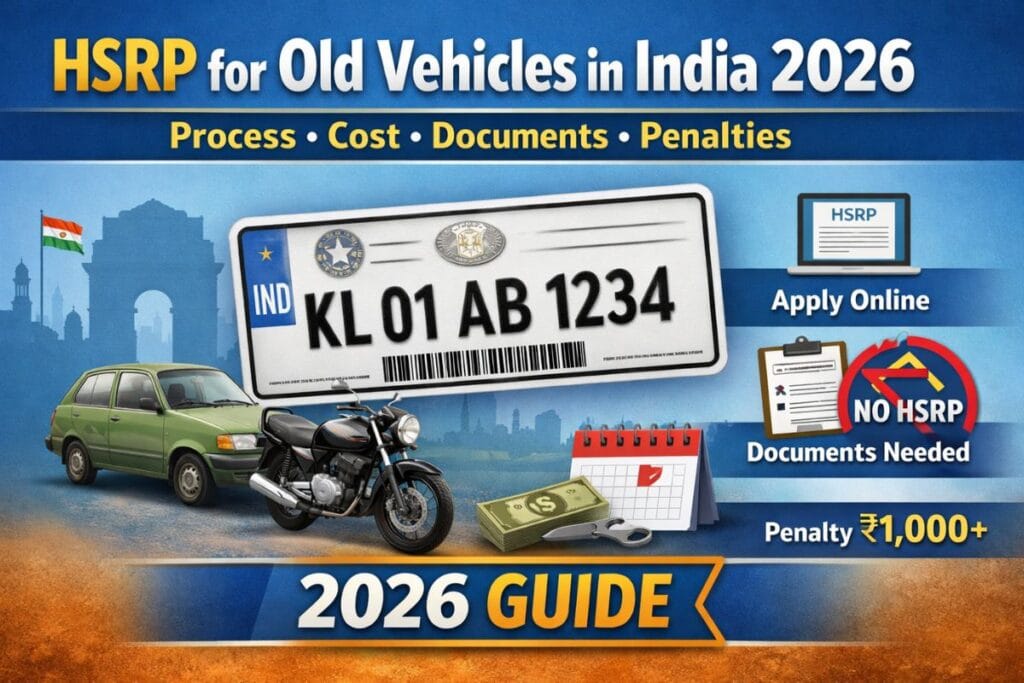
With the rapid growth of vehicle ownership in India, ensuring proper identification, safety, and regulation of vehicles became a major challenge for authorities. Traditional number plates were easy to duplicate, modify, or misuse, leading to rising cases of vehicle theft, fraud, and criminal activities.
To address these issues, the Government of India introduced High Security Registration Plates (HSRP) as a standardized and secure vehicle identification system.
In this article, we explain why HSRP was introduced, its role in security and theft prevention, and how it strengthens law enforcement across the country.
The Problem with Traditional Number Plates
Before HSRP was implemented nationwide, most vehicles used locally manufactured number plates. These plates had several limitations:
- No standard design
- No unique identification number
- Easy to duplicate
- No central database linkage
- Weak installation methods
- High scope for forgery
Criminals often exploited these loopholes to use stolen vehicles for illegal activities, evade traffic laws, and escape identification.
This lack of standardization created serious challenges for traffic police and investigation agencies.
Government Initiative Behind HSRP
To overcome these problems, the Ministry of Road Transport and Highways (MoRTH) introduced the HSRP system under the Central Motor Vehicles Rules.
The main objectives were:
- Create a uniform plate system across India
- Improve vehicle traceability
- Reduce auto-related crimes
- Support digital traffic management
- Strengthen road safety enforcement
HSRP became mandatory in phases for old and new vehicles in most states.
Key Reasons Why HSRP Was Introduced
Let us understand the major reasons behind the introduction of HSRP.
1. Enhanced Vehicle Security
One of the primary goals of HSRP is to improve vehicle security.
Each HSRP comes with:
- Laser-etched permanent identification number
- Chromium-based hologram
- Reflective film
- Tamper-proof snap locks
These features make the plate extremely difficult to copy or replace.
As a result, criminals cannot easily alter vehicle identities.
2. Strong Theft Prevention Mechanism
Vehicle theft is a major concern in many Indian cities. Stolen vehicles are often resold with fake number plates.
HSRP helps prevent this by:
- Making plates non-removable
- Linking plates to vehicle chassis and engine numbers
- Recording plate details in the VAHAN database
If a plate is damaged or removed, it cannot be reused.
This makes resale of stolen vehicles much harder.
3. Anti-Forgery and Anti-Tampering Features
Forgery and manipulation were common with old plates.
HSRP solves this through:
- Laser engraving that cannot be erased
- Government-approved holograms
- Secure embossing process
- Unique serial numbers
Any attempt to duplicate or modify an HSRP can be easily detected.
This protects both vehicle owners and authorities from fraud.
4. Support for Law Enforcement Agencies
HSRP plays a vital role in strengthening policing systems.
With HSRP:
- Cameras can easily read reflective plates
- ANPR (Automatic Number Plate Recognition) systems work efficiently
- Violators are identified instantly
- Stolen vehicles can be tracked faster
This improves traffic management, crime detection, and investigation speed.
5. Integration with Digital Transport Systems
HSRP is digitally linked with national transport databases such as VAHAN.
This allows authorities to:
- Verify ownership instantly
- Check insurance and pollution status
- Track violation history
- Monitor suspicious vehicles
Digital integration improves transparency and reduces manual errors.
6. Legal Backing and Regulatory Authority
HSRP is backed by central government regulations.
Under Central Motor Vehicles Rules:
- HSRP is mandatory for most vehicles
- Only authorized vendors can manufacture plates
- Unauthorized plates are illegal
- Penalties apply for non-compliance
This strong legal framework ensures nationwide implementation and uniformity.
Benefits of HSRP for Vehicle Owners
HSRP is not only beneficial for authorities but also for vehicle owners.
Key Benefits:
- Legal compliance
- Protection from theft
- Reduced risk of fraud
- Better resale value
- Faster recovery in case of loss
- Hassle-free verification
Having HSRP gives peace of mind and avoids unnecessary penalties.
Role of Color-Coded Stickers
Along with HSRP, a color-coded third registration sticker is issued.
It indicates:
- Fuel type
- Emission category
- Registration validity
This helps authorities quickly identify vehicle details without physical inspection.
Impact of HSRP on Road Safety
HSRP improves road safety by:
- Ensuring visibility at night
- Supporting automated challan systems
- Reducing fake registrations
- Encouraging responsible driving
Standardized plates make traffic systems more reliable and efficient.
Challenges During Implementation
While HSRP has many advantages, initial implementation faced issues such as:
- Limited fitment centers
- Long booking delays
- Public unawareness
- Technical glitches
However, most states have improved systems and infrastructure over time.
Final Thoughts
HSRP was introduced to create a secure, transparent, and technology-driven vehicle identification system in India.
By combining anti-forgery features, theft prevention mechanisms, digital integration, and legal authority, HSRP strengthens both vehicle security and law enforcement.
For vehicle owners, adopting HSRP is not just a legal requirement—it is a smart investment in safety and compliance.