India’s journey with High-Security Registration Plates (HSRP) represents a significant step towards modernizing vehicle identification and curbing related crime. While the system is now well-established domestically, it is insightful to view it through a global lens. How do India’s HSRP regulations stack up against international standards? What can be learned from the implementation successes and challenges in other nations? This analysis delves into a comparative study of vehicle registration plate systems worldwide, with a particular focus on European Union standards, to identify India’s position and potential future pathways for enhancement.
The Foundational Philosophy: Security vs. Standardization
Globally, the primary objectives for vehicle plates are consistent: unique identification, legibility for law enforcement, and a degree of security. However, the emphasis varies.
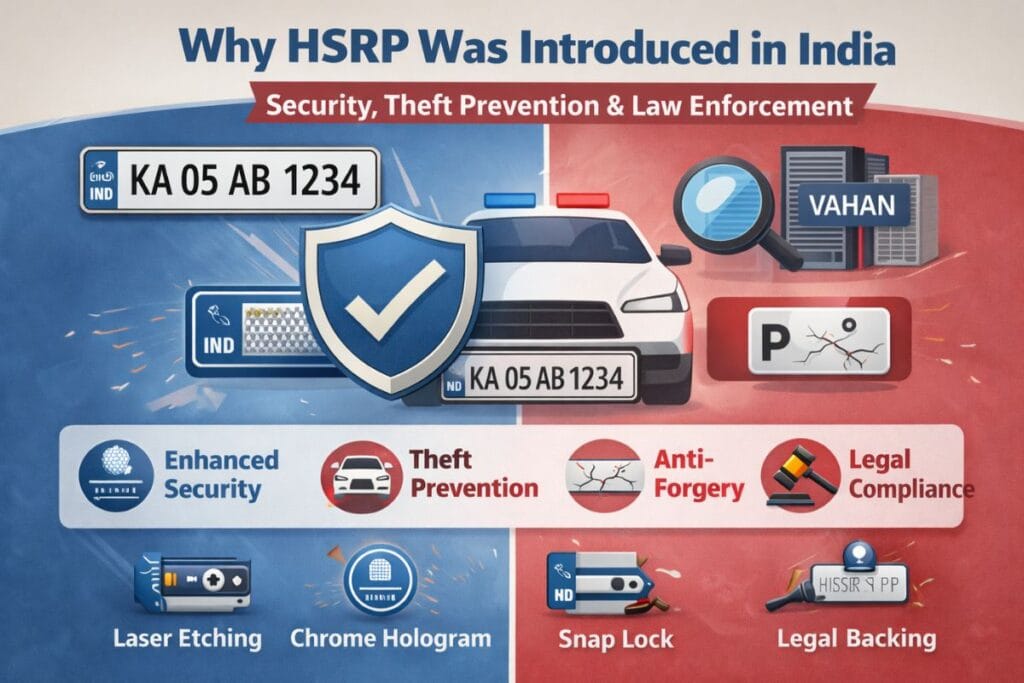
- India’s Approach (Security-First): Born from the need to combat widespread vehicle theft and forgery, India’s HSRP mandate is overwhelmingly security-centric. Every feature—the laser-etched PIN, snap locks, hot-stamped chromium foil, and ‘IND’ hologram—is designed to be a tamper-proof, non-replicable security device. The plate itself is a secure credential.
- European Approach (Standardization-First): The EU’s priority has been to create a standardized, pan-national format that facilitates free movement, cross-border enforcement, and easy recognition. Security features, while present, were often incorporated later and are not uniformly mandated across all member states.
- United States Approach (State Sovereignty): The U.S. has no federal standard for plate design or security. Each of the 50 states designs its own plates, leading to vast diversity. Security features are adopted piecemeal, with some states using embossing, reflective sheeting, and serialized stickers as anti-counterfeit measures.
This philosophical difference shapes the entire ecosystem, from manufacturing to enforcement.
Detailed Comparison: India’s HSRP vs. European Union Plates
The EU provides the most structured international counterpart for comparison due to its binding regulations.
| Feature | India (HSRP as per AIS 069 & CMVR Rule 50) | European Union (As per EU Regulation No. 2411/98 & subsequent) |
|---|---|---|
| Governing Principle | National Mandate (MoRTH) | Supra-national Regulation (European Commission) |
| Primary Goal | Prevent theft and tampering; Ensure authenticity | Ensure uniformity and legibility across member states |
| Dimensions | Standardized for 2/4 wheelers (500x120mm, 340x200mm common) | Standardized: 520x120mm or 520x110mm for most vehicles. |
| Visual Design | Strictly mandated: Blue strip on top with IND & PUC, standardized font (Charles Wright), border spacing. | Mandated Elements: Blue band on left with EU circle of stars & country code (e.g., D for Germany, F for France). Font, color, and rest of design are national prerogatives. |
| Key Security Features | 1. Laser-branded 10-digit PIN. 2. Non-reusable snap-lock system. 3. Chromium-based hot-stamping foil with ‘IND’ microtext. 4. Third registration mark sticker (for some states). | Not centrally mandated. Left to member states. Common features include: 1. Reflective backing (mandated). 2. Embossing. 3. National holograms/security stickers. 4. Nation-specific codes/engraving. |
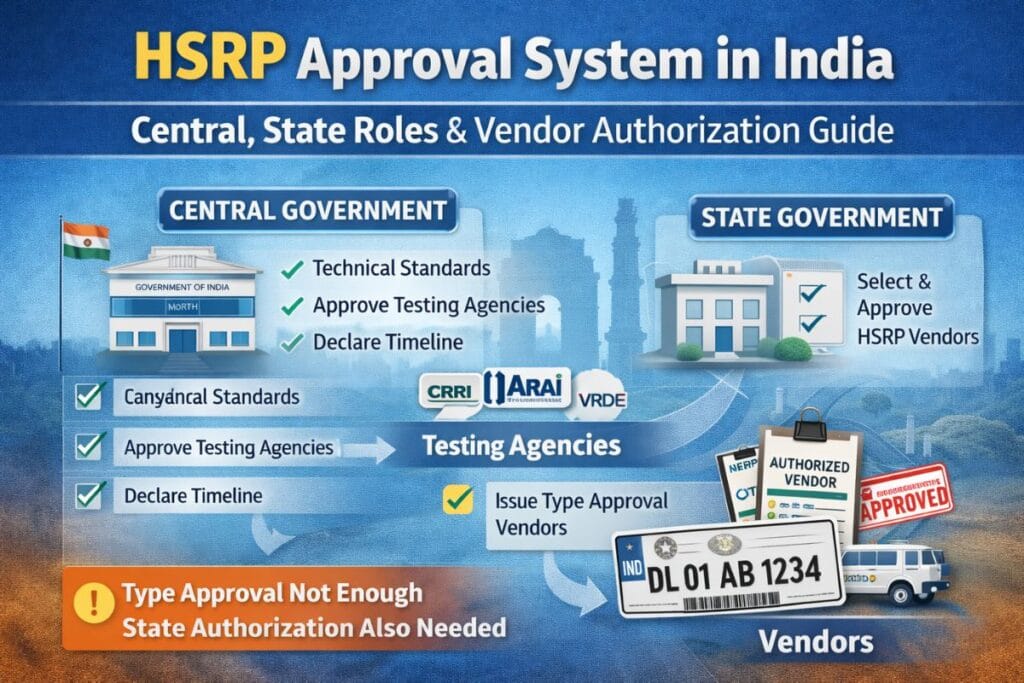
| Manufacturing Control | Highly centralized. ARAI Type Approval required. State-wise tenders to select few authorized vendors. | Decentralized. Approved manufacturers in each member state, adhering to national (not EU-wide) security specs. |
| Database Linkage | PIN on plate linked to central/state vehicle database (Vahan). | Varies by country. Many use plates as a visual key; digital enforcement relies on separate ANPR cameras linking to national databases. |
Key Takeaway: The EU standardizes the canvas (size, blue strip), but lets nations paint the picture. India standardizes both the canvas and the picture, with an additional, non-negotiable security layer embedded into the very fabric of the plate.
Learning from Global Implementation: Successes and Pitfalls
The European Model: Lessons in Interoperability
- Success: The EU format is a masterclass in creating a common visual language for 27 diverse nations. It enables citizens and authorities to instantly identify a vehicle’s origin, simplifying cross-border travel and law enforcement cooperation.
- Lesson for India: As India moves towards a more unified national vehicle registry (Vahan), the EU model underscores the value of a consistent, instantly recognizable plate format across all states. While India already has this, ensuring uniform enforcement and fitment quality in every district remains an ongoing challenge that Europe faced and largely overcame.
The United Kingdom (Post-Brexit): Agility in Updates
- Case Study: The UK, post-Brexit, introduced new number plates in 2021 with a revised font (
70d) designed to improve ANPR accuracy. They also shifted the national identifier code from an EU flag to the Union Jack. - Lesson for India: This demonstrates system agility. As technology (like ANPR) evolves, plate standards must adapt to maintain machine-readability. India’s HSRP standards, currently excellent for human and basic machine reading, may need periodic review to optimize for next-generation ALPR (Automatic License Plate Recognition) systems.
Countries like Germany and South Korea: Integration with Technology
- Germany: Uses sophisticated ANPR systems integrated with police databases in real-time. Their plates, while not as security-feature-heavy as India’s, are designed for high-fidelity optical capture.
- South Korea: Has explored and implemented digital license plates (e-plates) for commercial fleets, displaying dynamic information.
- Lesson for India: The true power of a registration plate is unlocked when it is part of an integrated, real-time enforcement and intelligence network. India’s focus has been on making the physical plate secure; the next phase must be integrating it more deeply with the National Register and traffic enforcement IT systems.
The Pitfall to Avoid: Inconsistent Rollout (A Global Issue)
Many countries, including some in the EU during early adoption, faced challenges with phased implementation, allowing old and new plates to coexist for decades. This creates a dual-system headache for enforcement. India’s state-by-state, phased rollout for older vehicles mirrors this challenge, underscoring the need for a firm, time-bound sunset clause for legacy plates.
Future Enhancements: A Roadmap for India’s HSRP
Drawing from global benchmarks, India’s HSRP system is poised for its next evolution. Here are potential future enhancements:
1. Integration of RFID (Radio-Frequency Identification) Tags:
- Global Precedent: Malaysia, some US states (like Washington for tolling), and others use embedded RFID tags.
- Potential for India: Embedding a passive UHF RFID chip (linked to the laser PIN) could enable contactless, high-speed identification at toll booths, parking lots, and border checkpoints. It would complement the visual and ANPR systems, working efficiently in poor weather or when the plate is dirty—a significant limitation for optical systems.
2. Standardization for Advanced ANPR/ALPR Systems:
- Future HSRP revisions could specify retro-reflective properties, font stroke width, and character spacing optimized for Indian conditions (dust, monsoons) and high-speed ALPR cameras, ensuring >99% accuracy.
3. Dynamic Elements for Special Use Cases (Following South Korea):
- Commercial & Fleet Vehicles: Exploring tamper-proof digital displays (e-plates) for logistics or rental vehicles could show real-time information like “On Duty,” “Taxi Hired,” or emergency alerts.
- Electric Vehicles (EVs): A distinct, permanent identifier or color-coding on HSRP for EVs, as done in some EU countries (green strips or text), can aid in policy enforcement (EV-only zones) and infrastructure planning.
4. Centralized, Real-Time National Database Integration (The Ultimate Goal):
- The laser-etched PIN is the perfect key. The future lies in ensuring every traffic police unit, RTO, and toll operator can instantaneously query the National Vehicle Registry (Vahan/Sarathi) using this PIN or an ANPR/RFID scan, receiving verified vehicle and owner details in real-time. This would make the HSRP a true “digital license” for the vehicle.
5. Strengthening the Supply Chain Against Counterfeits:
- Despite high security, counterfeit plates emerge. Learning from currency printing, a blockchain-ledger-based tracking system for each sheet of reflective foil and each hologram from manufacturer to fitment center could create an auditable, unbreakable chain of custody.
Conclusion: India’s Secure Foundation and the Road Ahead
India’s HSRP system, when viewed internationally, stands out for its robust, security-first engineering. It is, in many technical aspects, more secure at the point of manufacture than the baseline standards in Europe or the U.S. India successfully leapfrogged from a largely unregulated system to a high-security one in a single bound.
However, the global perspective teaches us that a plate is not an island. Its effectiveness is multiplied by the ecosystem it operates in. Europe excels in cross-border interoperability, the UK in adaptive design, and nations like South Korea in technological integration.
India’s next chapter should focus on integration and intelligence. By potentially layering RFID technology, optimizing for advanced ALPR, and, most crucially, ensuring seamless, real-time connectivity between the physical HSRP and the national digital vehicle database, India can build a world-leading vehicle identification and management system. The secure physical plate (HSRP) will then become the reliable anchor for a smarter, more efficient, and safer mobility ecosystem—a model that other nations may well begin to follow.
Disclaimer: This article provides an analytical comparison based on publicly available regulations and global trends. Specific technical specifications are subject to change by respective governing authorities. Readers are advised to refer to official MoRTH notifications for the definitive Indian HSRP standards.