High Security Registration Plates (HSRP) are an important part of India’s vehicle registration system. They help improve road safety, prevent vehicle-related crime, and ensure uniform identification of vehicles across the country. While many vehicle owners know that HSRP is mandatory, very few understand how the system is managed and who controls it.
In India, HSRP is implemented through a coordinated framework involving the Central Government, State Governments, and authorised technical agencies. Each authority has clearly defined responsibilities. Understanding this structure helps vehicle owners avoid misinformation and choose only genuine, government-approved services.
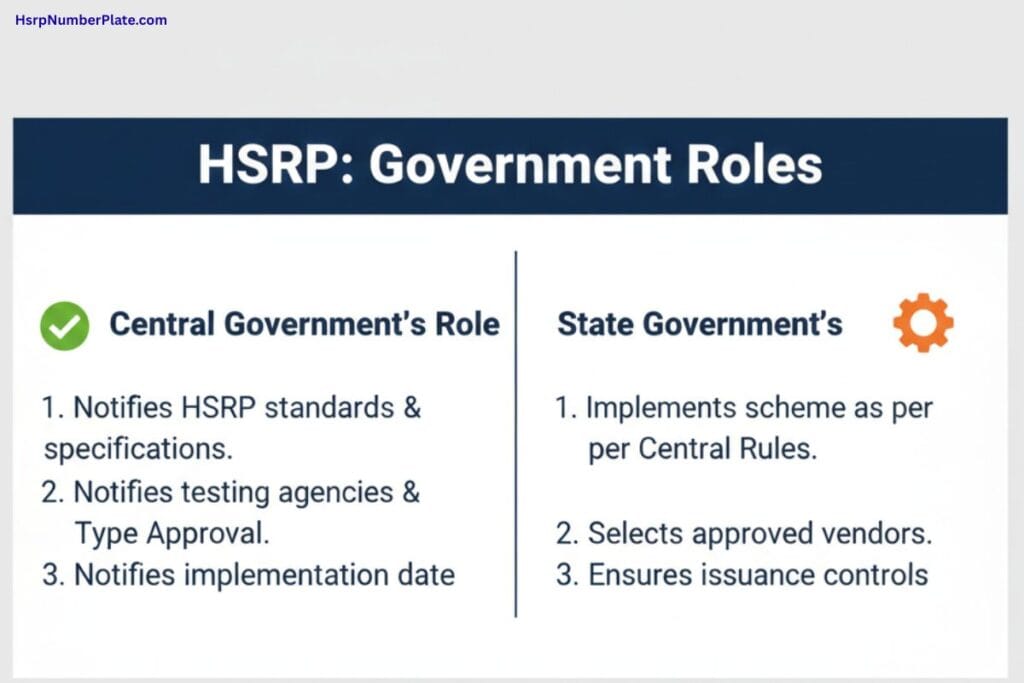
Role of the Central Government in HSRP
The Central Government, through the Ministry of Road Transport and Highways (MoRTH), plays a regulatory and supervisory role in the HSRP system. It does not directly handle the sale or installation of number plates.
One of the main responsibilities of the Central Government is to notify the technical standards and specifications of HSRP. These standards define the quality of material, reflectivity, size, security features, holograms, laser-etched codes, and locking mechanisms. All HSRP plates manufactured in India must follow these specifications. Neither states nor private vendors are allowed to modify these rules.
Another important role of the Central Government is authorising testing agencies. These agencies are responsible for examining whether HSRP products meet the prescribed standards. Only vendors whose plates pass these technical tests are considered eligible to operate under the scheme.
The Central Government also notifies the dates for implementation of HSRP. It decides when the scheme becomes mandatory for new vehicles and when older vehicles must switch to high-security plates. States may accelerate implementation, but they cannot dilute central rules.
It is equally important to understand what the Central Government does not do. It does not issue licences, appoint dealers, run booking websites, or grant franchises. All such operational activities are managed at the state level. Therefore, any individual or website claiming “direct Central Government authorisation” should be treated with caution.
Role of State Governments in HSRP
While the Central Government sets the policy framework, State Governments are responsible for actual execution. Each state’s transport department manages HSRP operations within its jurisdiction.
States implement the scheme according to Central Motor Vehicles Rules and MoRTH guidelines. They design local systems for booking, fitment, monitoring, and public awareness. This is why the application process and portal may differ from one state to another.
A major responsibility of State Governments is selecting HSRP vendors. Vendors are chosen through official tender and bidding processes. Only companies that have valid Type Approval Certificates from authorised testing agencies are allowed to participate. After selection, the state signs agreements with vendors for manufacturing and installing plates.
State Governments are also responsible for quality control. They monitor whether plates are being manufactured correctly, installed properly, priced fairly, and linked accurately with vehicle databases. Transport authorities conduct inspections and audits to ensure that vendors follow rules.
Enforcement is another key responsibility. State transport departments, along with traffic police, conduct checks, issue challans, and take action against vehicles without valid HSRP. They may also restrict certain RTO services if a vehicle owner fails to comply.
Role of Authorized Testing Agencies
Between the Central and State Governments, authorised testing agencies play a crucial technical role. These agencies evaluate whether HSRP manufacturers meet government standards.
In India, three agencies are authorised for this purpose: Central Road Research Institute (CRRI) in Delhi, Automotive Research Association of India (ARAI) in Pune, and Vehicle Research & Development Establishment (VRDE) in Ahmednagar.
These institutions test plate durability, reflectivity, security features, manufacturing processes, and data integrity. Only after successful testing do they issue Type Approval Certificates. Without this certification, no vendor can legally participate in state HSRP schemes.
This technical scrutiny ensures that low-quality or unsafe plates do not enter the market.
Authorized Type Approval Vendors and Their Role
For any company to manufacture High Security Registration Plates in India, it must first obtain a Type Approval Certificate from one of the authorised testing agencies such as CRRI, ARAI, or VRDE. These certificates are issued only after detailed technical testing of plate material, security features, reflectivity, durability, and manufacturing processes.
In the past, several companies across India have received such type approval from these agencies after meeting government standards. These approved manufacturers were recognised as technically capable of producing HSRP plates as per Central Motor Vehicles Rules.
However, it is very important for vehicle owners to understand that getting type approval alone is not enough to sell or install HSRP in any state. Even after receiving certification, a vendor cannot directly start operating. The company must also be selected and authorised by the concerned State Transport Department through its official tender and approval process.
Only vendors who have both valid type approval and formal state-level authorisation are legally allowed to sell and affix HSRP plates in that state. If a company has type approval but does not have state permission, it is not authorised to provide HSRP services there.
Therefore, vehicle owners should always verify that the vendor is approved by their state transport department and not rely only on claims of “type approval” or “central certification.” This dual approval system exists to ensure quality, accountability, and consumer protection.
Who Is Allowed to Sell and Install HSRP?
Any company interested in manufacturing or installing HSRP must first obtain Type Approval from one of the authorised testing agencies. After that, the company must qualify in the state’s tender process and be formally selected by the State Government.
Only after completing these steps can a company legally sell and affix HSRP plates in that state. Approval in one state does not automatically allow operation in another state.
This system ensures that only technically competent and financially stable vendors operate in the HSRP ecosystem.
Licensing and Franchise Policy
A common misconception among vehicle owners is that HSRP vendors are licensed directly by the Central Government. This is not true.
The Central Government does not issue licences, franchises, or distributorships for HSRP. Vendors work under agreements signed with State Governments after completing the required approval process.
Any agent or website claiming to be a “Central Government authorised dealer” should be verified carefully, as such claims are often misleading.
Implementation Timeline of HSRP in India
The HSRP scheme was originally introduced for new vehicles from May 2005. Older vehicles were given additional time to switch to high-security plates. Over the years, the rules have been strengthened and extended to cover almost all registered vehicles in India.
Today, both new and old vehicles are expected to comply with HSRP norms, and enforcement has increased significantly across states.
Why This System Matters for Vehicle Owners
The multi-level HSRP governance structure exists to protect vehicle owners and ensure nationwide uniformity. Central standards guarantee quality, testing agencies ensure technical reliability, and state authorities monitor daily operations.
Together, this system helps prevent fake plates, controls pricing, supports law enforcement, and reduces fraud. It also makes it easier for authorities to trace stolen or misused vehicles.
For vehicle owners, this means better security, legal compliance, and peace of mind.
Important Guidance for Vehicle Owners
Vehicle owners should always use official state portals and authorised fitment centres when applying for HSRP. It is advisable to keep payment receipts, appointment slips, and installation records safely.
Roadside sellers, unofficial agents, and social media advertisements should be avoided. Using non-standard plates can result in fines and legal complications.
If there is any doubt about a vendor’s authenticity, the state transport department website should be consulted.
Conclusion
HSRP implementation in India follows a well-defined and transparent system. The Central Government sets technical standards and policies, authorised agencies certify manufacturers, State Governments manage operations and enforcement, and approved vendors handle manufacturing and installation.
This structure ensures quality, accountability, and uniformity across the country.
For vehicle owners, understanding this system is important for avoiding misinformation and ensuring legal compliance. By following official procedures and relying on authorised channels, you can obtain genuine HSRP plates and drive without legal risk.